#E0091 Mental Health Care: A Missing Piece in COVID-19 Protection?

Mental Health Care: A Missing Piece in COVID-19 Protection?
Although there is limited research on the impact of major depressive disorder, commonly known as depression, as a risk factor for COVID-19 breakthrough infections, studies have demonstrated a link between depression and common viral infections. Countries such as Italy and Japan reported a post-pandemic surge in depression cases in the general population. In Japan, COVID-19 vaccinations were 61.8% complete in the general population by October 2021, yet post-vaccination breakthrough infections were reported, indicating that vaccination alone was not an effective infection control measure. The question then is: “What is the missing link?”
Researchers have hypothesized that behavioral restrictions may potentially trigger post-vaccination breakthrough infections. However, the research on this topic is limited. Therefore, this study explored the question: “Can depression make someone more likely to get COVID-19 even after they have been vaccinated?” The Center for Epidemiologic Studies Depression Scale (CES-D) positivity was used as a risk index in a matched case-control study among hospital staff. If there is, indeed, a correlation between depression and breakthrough infections, it will be necessary to integrate mental health care for affected populations, along with infection control measures.
The study was conducted among 2,163 full-time employees at Juntendo University Hospital, one of the largest university hospitals in Japan, from April 2020 to November 2021. Only employees who tested positive for the COVID-19 virus (SARS-CoV-2) and those with a clinical diagnosis based on the presence of symptoms like fever and respiratory difficulties combined with a history of close contact with infected persons were included in the study. The study participants were identified from the Department of Safety and Health Promotion’s staff list of patients with COVID-19.
Age, gender, BMI, medical history, physical symptoms, and mental well-being (as measured by the CES-D) were assessed and analyzed. CES-D positivity was found in 34.2% of the employees in the study population, and results of the analysis indicated that the employees who screened positive for depressive symptoms were over four times more likely to develop COVID-19 breakthrough infections than those without depressive symptoms. The findings also indicated that the percentage of employees with CES-D positivity was significantly higher in the breakthrough infection group than in the control group.
Studies have shown a direct link between depression and compromised immunity, which may explain why CES-D positivity increases the risk of infection. Therefore, improving mental health care may be a valuable component of infection control measures.
Link to original journal article:
https://www.jstage.jst.go.jp/article/eohp/6/1/6_2024-0007-OA/_article
Title of the paper:
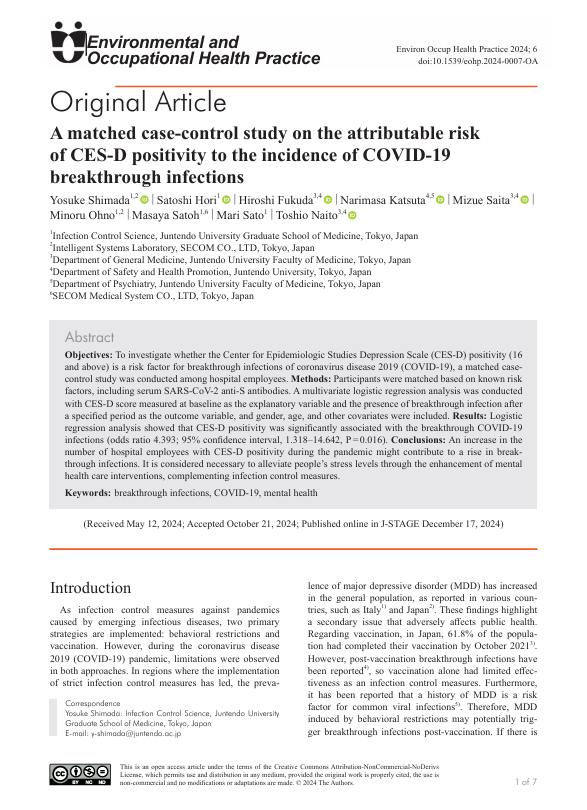
A matched case-control study on the attributable risk of CES-D positivity to the incidence of COVID-19 breakthrough infections
Authors:
Yosuke Shimada, Satoshi Hori, Hiroshi Fukuda, Narimasa Katsuta, Mizue Saita, Minoru Ohno, Masaya Satoh, Mari Sato, Toshio Naito