#E0092 The effects of online Acceptance and Commitment Therapy Program on workplace wellbeing in Japan

The effects of online Acceptance and Commitment Therapy Program on workplace wellbeing in Japan
Young employees often face stress and life‑balance challenges. Acceptance‑and‑Commitment Therapy (ACT) is a mindfulness‑based approach that has been shown in some workplace studies to improve psychological flexibility and reduce distress. However, evidence for ACT delivered in short online group sessions to early‑career staff is limited.
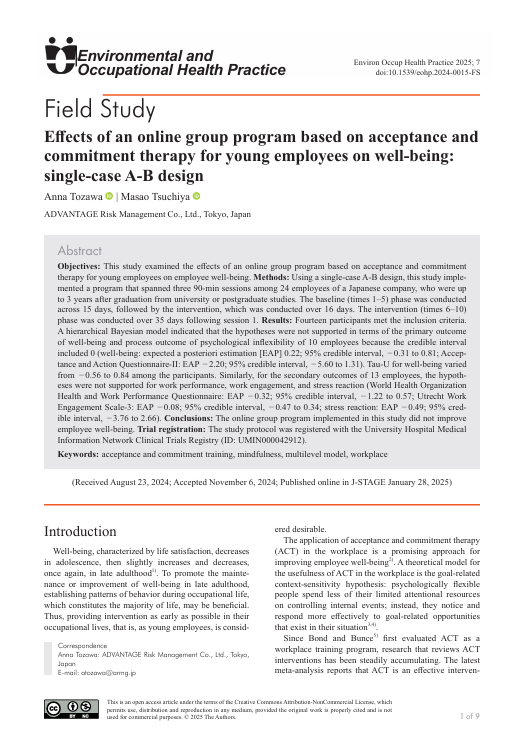
The researchers in Japan conducted a study to examine the effects of an online group program based on ACT for young employees on well-being, work performance (WP), work engagement (WE), stress reactions, frequency of valued actions, and psychological inflexibility (PiF). The study hypothesized that each indicator would exhibit a better trend for each participant after the intervention. The researchers employed a single A-B design, with participants concurrently starting in the baseline (phase A) and intervention (phase B) phases. The study involved 24 employees from Company A, all within three years of graduating from university or completing postgraduate studies. Company A operates in the service sector, focusing on providing mental health care services to companies in Japan. The intervention consisted of an online group program based on ACT for 12 participants per group, conducted via Microsoft Teams® video conferencing. It included three sessions, each lasting 90 minutes. The baseline phase (times 1–5) was conducted over 15 days, followed by the intervention phase (times 6–10), which spanned 35 days.
Fourteen participants met the inclusion criteria. A hierarchical Bayesian model indicated that the hypotheses were not supported regarding the primary outcome of well-being and the process outcome of psychological inflexibility for 10 employees. Similarly, for the secondary outcomes involving 13 employees, the hypotheses were not supported for work performance, work engagement, and stress reactions. No indicators supported the hypothesis: the primary outcome of well-being, the secondary outcomes of WP, WE, and stress reactions, and the process outcome of PiF. Furthermore, regarding the Tau-U of the participants, more than half exhibited moderate or larger positive changes in PiF, while more than half showed small changes in well-being, including many negative changes, with no consistency across participants. This study highlighted the online group program based on ACT for young employees did not improve well-being.
For occupational health practitioners and researchers, these results suggest that a brief online ACT group may not be sufficient to enhance early‑career employees’ overall well‑being. Further research with more extensive interventions and refined measures is needed to identify the most effective strategies for supporting young workers’ mental health and job performance.
Link to original journal article:
https://www.jstage.jst.go.jp/article/eohp/7/1/7_2024-0015-FS/_article
Title of the paper:
Effects of an online group program based on acceptance and commitment therapy for young employees on well-being: single-case A-B design
Authors:
Anna Tozawa , Masao Tsuchiya
DOI:
10.1539/eohp.2024-0015-FS