#E0094 Does health and productivity management enhance retention and health outcomes of staff in Japanese hospitals?

Does health and productivity management enhance retention and health outcomes of staff in Japanese hospitals?
Medical workers often face long working hours due to staff shortages and demanding shifts. These extended hours are linked to increased alcohol consumption, obesity, and poor sleep, which can lead to various health problems. The decline in the health of medical workers not only raises the risk of medical errors but also impacts patient safety. Consequently, managing the health-related aspects of medical workers and promoting their well-being is crucial.
In Japan, the concept of health and productivity management (H&PM) is gaining attention. However, medical institutions in Japan struggle to maintain and enhance the health of their staff while also securing and retaining them, largely due to challenging work environments characterized by long hours and night shifts. Examining whether H&PM can improve staff health in medical institutions is expected to enhance organizational productivity and ensure the continuous delivery of high-quality medical services.
The researchers of this study examined the impacts of H&PM on health outcomes and staff retention in Japanese hospitals. A total of 2,000 hospitals participated in the questionnaire distribution, including 105 certified hospitals and 1,895 non-certified hospitals. A logistic regression model was used to analyze the relationship between H&PM and health-related attributes. The study considered the implementation status of H&PM and certification status as explanatory variables, while bed classification, the number of full-time staff, and the ratio of female staff were treated as moderator variables. The health-related attributes, assessed through average monthly overtime hours for physicians and nurses, smoking rates, the percentage of staff with exercise habits, the percentage of staff getting sufficient sleep, and the percentage of staff maintaining a healthy body weight, served as objective variables.
In this study, among health-related attributes, the average monthly overtime hours of physicians showed a significant association with H&PM implementation status. Additionally, hospitals with clearly written policies regarding H&PM promotion demonstrated a significant positive association. However, the presence of full-time occupational health staff, an understanding of health issues, the formulation of plans, and regular management training were not associated with average monthly physician overtime hours.
Positive associations were found within hospital groups, including the implementation group and the certification group. Furthermore, hospitals with full-time professionals dedicated to promoting H&PM exhibited a significant positive association. No statistically significant differences were identified in the relationships between H&PM implementation status and other health-related attributes. These findings suggested hospitals practicing H&PM may provide shorter overtime hours for physicians and contribute to a healthier working environment.
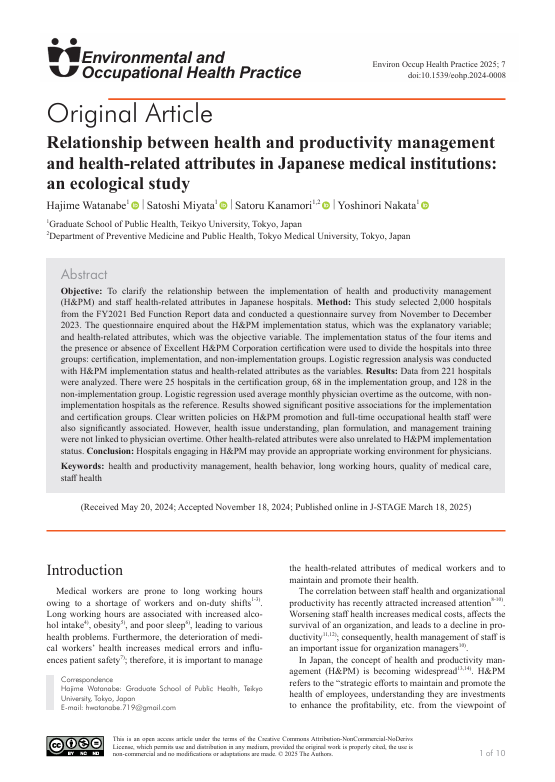
Link to original journal article:
https://www.jstage.jst.go.jp/article/eohp/7/1/7_2024-0008/_article
Title of the paper:
Relationship between health and productivity management and health-related attributes in Japanese medical institutions: an ecological study
Authors:
Hajime Watanabe, Satoshi Miyata, Satoru Kanamori, Yoshinori Nakata