
#E0096 Examining gender variations in self-rated health among teleworkers raising children

Examining gender variations in self-rated health among teleworkers raising children
Tele‑working, or working from home, has grown rapidly, especially during the COVID‑19 pandemic. For parents who also care for children, this flexible arrangement can improve work‑family balance but may also create new health challenges. A 2025 study examined what factors are linked to how tele‑working parents rate their own health, with a focus on differences between men and women.
To investigate gender differences in self-rated health among teleworkers raising children, a nationwide online survey was conducted in Japan. The researchers, gathered data from 1,000 parents (500 men, 500 women) who had been tele‑working and had at least one child under 18 years old. Respondents reported their hours of tele‑work, time spent on housework and childcare, self‑rated health (“very healthy,” “somewhat healthy,” “not very healthy,” “not healthy”), work‑family balance, and a set of healthy behaviors (sleep, exercise, diet, mood, etc.). Separate logistic‑regression models were run for each gender to identify variables most strongly linked to being in the “healthy” group. The following data is collected and analyzed:
1-Gender comparisons of the time spent teleworking, time spent on housework and childcare, and work-life balance subscale scores.
2-The relationship of marital status between men and women in the healthy and unhealthy groups.
3-Assessing the variables related to self-rated health was performed for men and women.
The results showed that the participants were generally healthy adults in their late thirties. Women spent almost twice as much time on housework and childcare as men. For mothers, telework allowed greater flexibility to match their work hours with family needs, but it also increased the risk of developing irregular daily routines. Women tended to have healthier lifestyles overall, which may explain their higher self-rated health scores. They generally maintained appropriate body weight, making weight-gain measures less relevant. For female teleworkers, keeping a regular routine appeared important for maintaining good health.
Among men, smoking was more common. They were more likely than women to engage in light exercise at least twice a week, but many also reported irregular eating habits, such as eating late at night. Married men more frequently experienced weight gain of 10 kg or more since their twenties. Overall, middle-aged men showed higher rates of regular exercise than women, but also more lifestyle habits associated with poorer health.
Health‑support programmes for tele‑working parents should be gender‑sensitive. In teleworkers raising children, men need to maintain connections with the local community and maintain physical activity and exercise for health management. For women, a disciplined lifestyle is necessary.
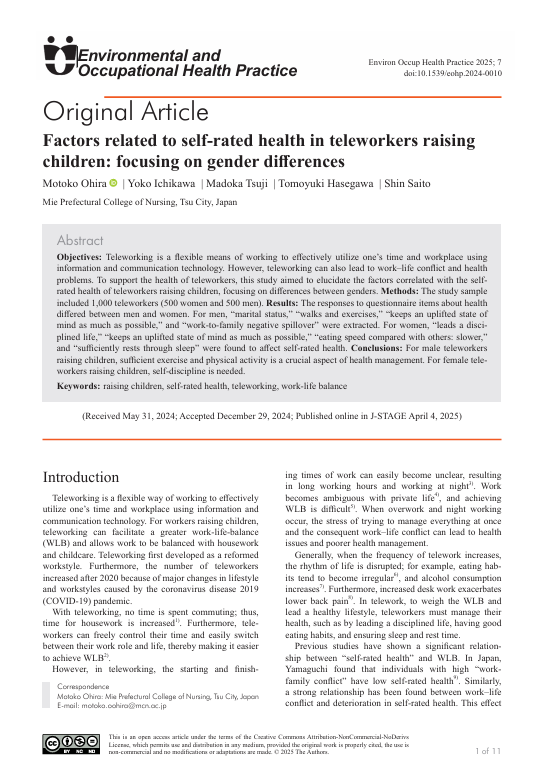
Link to original journal article:
https://www.jstage.jst.go.jp/article/eohp/7/1/7_2024-0010/_article
Title of the paper:
Factors related to self-rated health in teleworkers raising children: focusing on gender differences
Authors:
Motoko Ohira, Yoko Ichikawa, Madoka Tsuji, Tomoyuki Hasegawa, Shin Saito
DOI:
10.1539/eohp.2024-0010