
#E0098 A survey of long working hours among obstetricians and gynecologists employed in hospitals and related factors.

A survey of long working hours among obstetricians and gynecologists employed in hospitals and related factors.
In Japan, doctors are known for working much longer than many other professions. For obstetricians and gynecologists (OB‑GYNs), long hours can increase stress, fatigue, and risk of health problems. In 2019 the Japanese Ministry of Health introduced reforms aimed at cutting overtime for hospital‑based physicians, but whether they worked less remains unclear.
Physicians tend to work far longer hours than most other professionals. About 42% of full-time doctors work more than 200 days a year and over 60 hours a week much higher than the average of 14% across all professions. Among them, hospital-based obstetricians and gynecologists have some of the most demanding schedules, with around 20% logging over 1,920 hours of overtime annually, often exceeding 80 hours of work per week. To address this, Japan’s Ministry of Health, Labour and Welfare introduced physician work-style reforms in April 2024, setting a general annual overtime limit of 960 hours, with certain exceptions allowing up to 1,860 hours.
The Japan Society for Occupational Health reported a correlation between extended working hours and various health issues, including depression, anxiety, sleep disturbances, heart disease, and suicidal tendencies. This study examined whether nationwide physician‑work‑style reforms introduced in 2019 have reduced the weekly hours of hospital‑based OB / GYNs and identified characteristics that still predict prolonged work.
In this research, a web-based questionnaire was distributed to the heads and obstetrician-gynecologists of 1,170 hospitals across the country in November 2023. The survey gathered data on demographic and professional traits of the participating OB/GYNs, including their sex, age, job title, teaching responsibilities, family size, weekly working hours, frequency of out-of-hours shifts, hospital type, total bed count, and regional specifics.
The survey found that 26% of obstetricians and gynecologists worked more than 60 hours a week, and 5.4% worked more than 80 hours. These figures are much lower than those from a 2019 survey by the same authors, in which 84.1% worked over 60 hours and 46.6% worked over 80 hours per week, indicating a meaningful reduction in working hours. Even so, some OB/GYNs continue to face demanding schedules. Working 60 hours or more was more common among men, senior residents, those with teaching duties, and those taking frequent overnight shifts. The findings also highlight Japan’s low gender-equality context, suggesting a need for policy support. Potential ways to further reduce long hours include improving efficiency, redistributing tasks, and refining reporting practices.
Overall, the reforms have had a noticeable but incomplete effect. To protect physician health and patient safety, targeted interventions are needed: stricter enforcement of overtime limits, support for residents and educators, and systemic changes such as better distribution of staff and resources. These measures could further reduce the burden of long working hours for Japanese OB / GYNs.
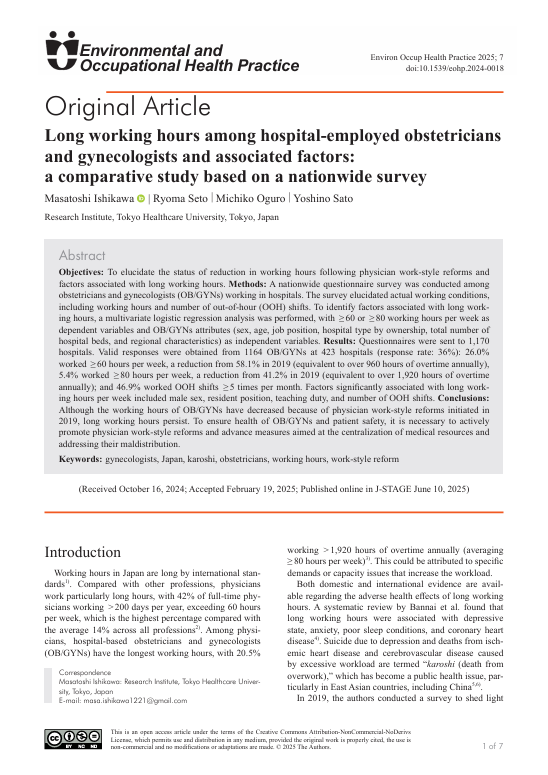
Link to original journal article:
https://www.jstage.jst.go.jp/article/eohp/7/1/7_2024-0018/_article
Title of the paper:
Long working hours among hospital-employed obstetricians and gynecologists and associated factors: a comparative study based on a nationwide survey
Authors:
Masatoshi Ishikawa, Ryoma Seto, Michiko Oguro, Yoshino Sato