#E0099 Nudging workers with abnormal findings on workplace screening to visit a medical facility

Nudging workers with abnormal findings on workplace screening to visit a medical facility
Workplace health checkups, and other health assessments that are done outside healthcare facilities, commonly ask individuals with abnormal findings to report to a medical center for further assessment and intervention where necessary. Such health checkups are only effective when those that have abnormal findings follow- through to complete these procedures.
Each year, workers at Japanese Transportation Company undergo routine examinations for non-communicable disease such as hypertension (high blood pressure), hyperglycemia (high blood sugar), and hyperlipidemia (excess of fats in the blood) among other diseases, receive their results one month later. Those with abnormal findings are asked to make an appointment at a medical facility and report the appointment date to the occupational health staff at their company within 3 weeks. However, less than half of individuals with abnormal findings follow these instructions.
In this research, authors developed a reminder system to promote “appointment-making” after yearly check-ups among individuals found to have abnormal findings during annual workplace examinations in 2024. The system specified the department where an individual should go based on the findings of specific test results, for example to visit an eye clinic based on vision tests, a chest clinic based on abnormal breathing and chest examination findings, etc. The system also asked them to report their appointment dates to their company’s occupational health staff. The authors then applied their reminder system to workers with abnormal findings and compared the “appointment-making” rates to those made over the same period in 2023 at the same company.
Almost all workers underwent health checkups in 2024 and two thirds of them received their results within one month; about half (49%) of those who had received their results had abnormal findings. All those with abnormal finding received a “nudge” to make an appointment at a medical facility and more than half of them (53.3%) went on to make an appointment at a medical center compared to only two fifths (43.8%) the previous year. The workers that made an appointment after receiving a reminder in 2024 were older than those who did not. Since almost all workers were male, “appointment-making” rates in 2024 did not differ by the sex of the workers.
The authors attribute the success of their reminder system to its simplicity and the fact that it allowed workers to commit to an appointment day of their choice. Going forward, the authors will send out repeat reminders to the workers who are yet to make appointments. A low‑cost, transparent reminder can improve worker engagement in preventive health care, addressing a common gap in occupational health. The findings support scaling such reminders, especially if combined with later “reminder” messages that incorporate additional nudges.
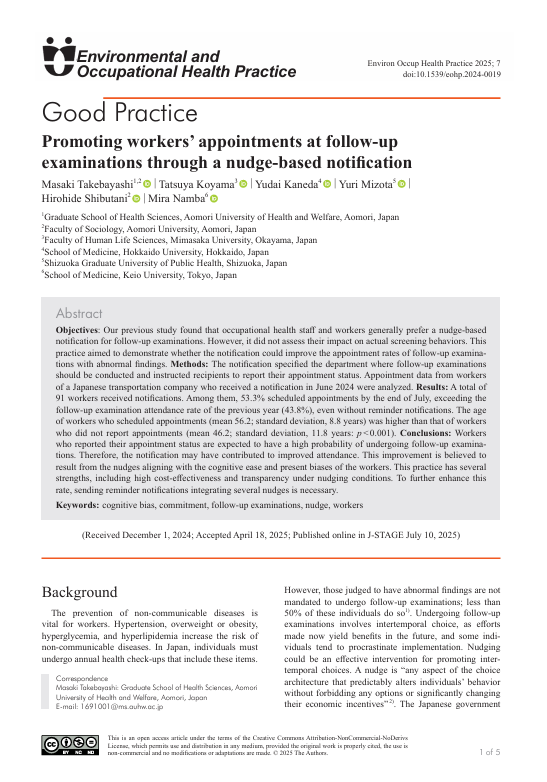
Link to original journal article:
https://www.jstage.jst.go.jp/article/eohp/7/1/7_2024-0019/_article
Title of the paper:
Promoting workers’ appointments at follow-up examinations through a nudge-based notification
Authors:
Masaki Takebayashi, Tatsuya Koyama, Yudai Kaneda, Yuri Mizota, Hirohide Shibutani, Mira Namba