#E0100 High Carbon‑Dioxide Levels inside Vehicles Can Undermine Taxi Drivers’ Automated Driving Skills

High Carbon‑Dioxide Levels inside Vehicles Can Undermine Taxi Drivers’ Automated Driving Skills
Most taxis and buses operate with their windows closed or the air conditioning set to recirculate cabin air. This practice can raise inside carbon dioxide (CO2) levels to thousands of parts per million, far above the ~400 ppm found outdoors. In this study, researchers determined whether CO2 levels inside cars can influence driving performance and cognitive function. While most people think about CO2 as a greenhouse gas in the atmosphere, it can also build up in enclosed spaces such as vehicles. This study investigated an important question: does breathing in higher levels of CO2 affect how well drivers perform behind the wheel?
To evaluate this, eight taxi drivers were subjected to a driving simulator experiment. The researchers compared two conditions: one with normal CO2 levels (less than 500 parts per million, similar to fresh air) and one with very high CO2 levels (around 5,000 parts per million, which can occur in poorly ventilated cars). The drivers were tested on several measures, including a driving assessment based on official license test criteria, a reaction-time task using flashing lights, and a memory task known as the “two-back” test.
The results of this study were particularly noticeable with skill-based behaviors compared to memory-based behaviors. Under high CO2 conditions, drivers made more mistakes such as wobbling in their lane, failing to signal, making contact with obstacles, and drifting out of their lane. Reaction times in the light-response task were also slower, showing that alertness and quick decision-making were impaired. Interestingly, the memory task did not show significant changes, suggesting that CO2 mainly affected skill-based driving behaviors rather than tasks requiring working memory.
These findings highlight a hidden risk in everyday life. Many drivers may not realize that CO2 can accumulate inside cars, especially when ventilation is poor or when vehicles are occupied for long periods. The study suggests that managing CO2 levels in vehicles is important for maintaining safe driving. Practical measures could include developing systems that monitor and control CO2 inside cars, improving ventilation designs, and educating drivers about the importance of fresh air.
In summary, the findings of this study suggest that high CO2 levels can negatively affect driving performance, increasing the risk of accidents. While memory and thinking tasks may remain stable, the skills most critical for safe driving such as lane control, signaling, and reaction speed are compromised. By raising awareness and encouraging better air management in vehicles, this study points to a simple but effective way to improve road safety.
Link to original journal article:
https://www.jstage.jst.go.jp/article/eohp/7/1/7_2025-0001/_article
Title of the paper:
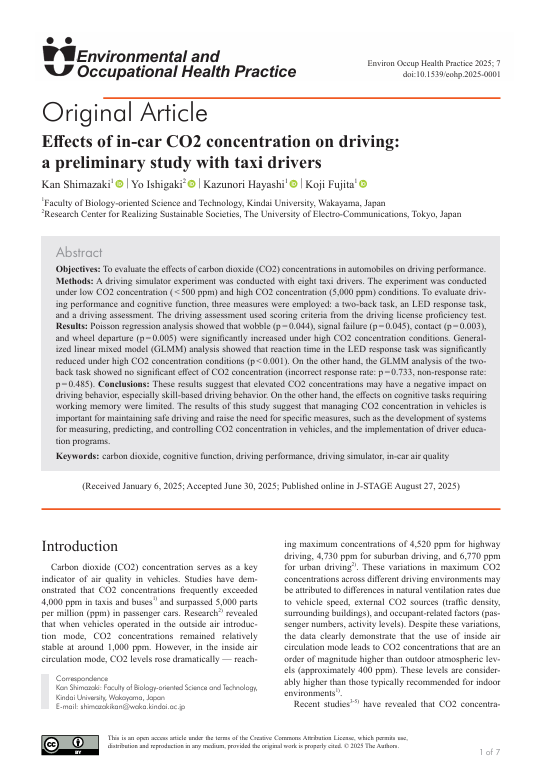
Effects of in-car CO2 concentration on driving: a preliminary study with taxi drivers
Author:
Kan Shimazaki, Yo Ishigaki, Kazunori Hayash, Koji Fujita