#E0084 Can digital health technologies promote mental health well-being and reduce work-related stresses among employees?

Can digital health technologies promote mental health well-being and reduce work-related stresses among employees?
Digital health technologies include variety of information and communications tools, devices, connectivity software, computing platforms and sensors used in healthcare for health promotion, disease prevention, disease management and rehabilitation. They range from mobile health (mHealth) applications, health information technology (IT), wearable devices, telehealth and telemedicine such as online counselling services, and personalized medicine. Countries like the United Kingdom, Germany and the United States of America already have established laws that govern the provisions of health services.
Workplaces, where employees spend most of their time, are suitable locations to provide health services. Digital health technologies can be used to enhance the mental health of employees at workplaces. But Japan has not yet established guidelines for digital mental health services
The authors, part of a research group named Developing Minds-compliant guidelines for General preventive intervention using digital Health Technologies for mental health ([DeLiGHT]), sought to investigate whether workplaces in Japan could be used to provide digital mental health services.
Following several rounds of expert consultations, the authors defined digital health technologies for mental health services as provision of services to prevent drug and alcohol abuse and suicide. They identified various digital platform such as smartphones (including voice calls), video conferencing, web-based platforms (including web chats), text messaging, mobile health applications (apps), robots, wearable devices, and non-contact sensing devices. Such services may include information provision, digital counselling, self-monitoring, real-time feedback, and treatment services.
Using this definition, the authors evaluated the proportion of employees in Japan who had ever used digital mental health services. They conducted an on-line survey of 1001 and 1500 respondents who had and had not used digital mental health services, respectively, registered with the online survey company Rakuten Insight Inc. (Tokyo, Japan) who had used digital mental health services at the workplace in February 2023.
The survey found that individuals had ever used digital mental health services were younger males with university-level educational that were full-time employment doing non-manual jobs in the manufacturing industry in companies that employed 5000 or more employees. Employees who had ever used digital mental health services mainly accessed them through their employers; however, the authors did not investigate the duration and frequency of the use of such services, nor their impact on the mental health of the users.
The workplace in Japan could serve as a suitable location to enhance the mental health services of its population. The authors suggest that Japanese government should establish guidelines to provide digital mental health services that are suitable for Japanese workers.
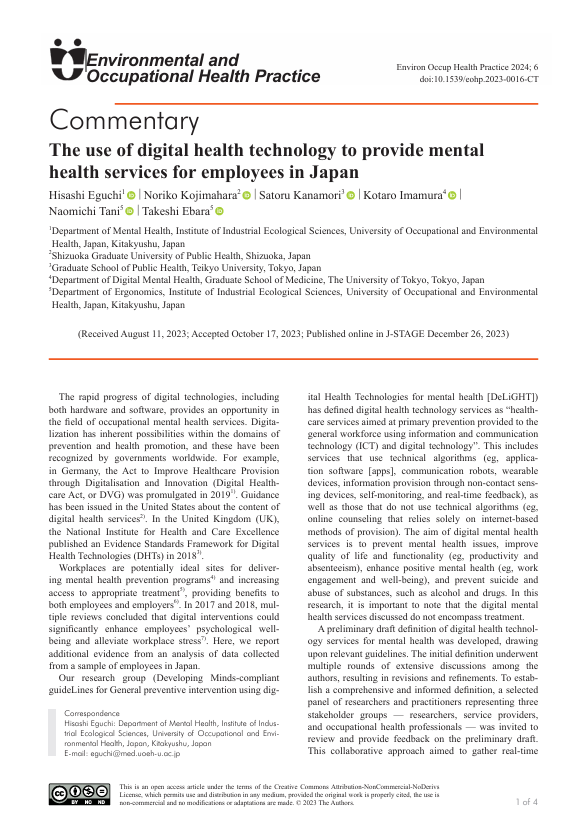
Link to original journal article:
https://www.jstage.jst.go.jp/article/eohp/6/1/6_2023-0016-CT/_pdf/-char/en
Title of the paper:
The use of digital health technology to provide mental health services for employees in Japan
Authors:
Hisashi Eguchi, Noriko Kojimahar, Satoru Kanamori, Kotaro Imamura, Naomichi Tani, Takeshi Ebara.