
#E0085 Enhancing Workplace Health in Indonesia: Insights from Public Health Centers

Enhancing Workplace Health in Indonesia: Insights from Public Health Centers
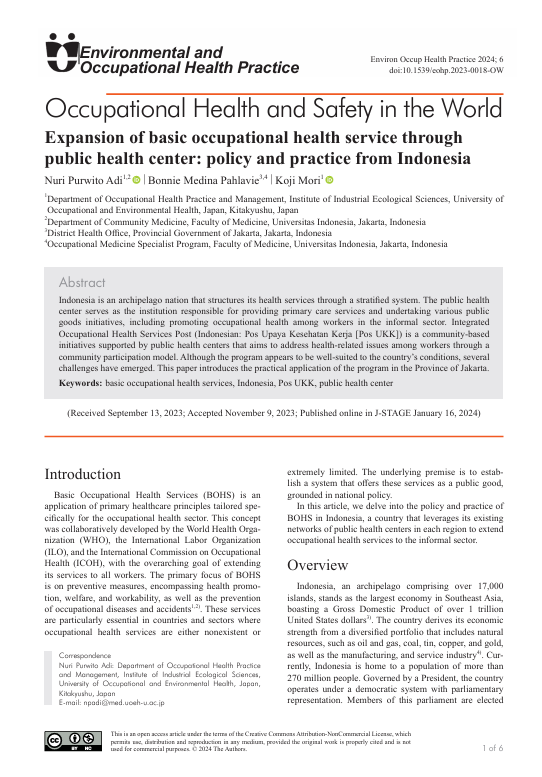
Indonesia, a country with a large and diverse population, has been actively working to improve its occupational health services. The country's healthcare system is a hybrid model that incorporates both public and private providers and financing mechanisms. This article examines, the expansion of basic occupational health services (BOHS) through public health centers in Indonesia.
This study investigated “Basic Occupational Health Services” (BOHS), a method where measures are taken to improve health and protect persons involved in different occupations including workers who are not paid directly by the government. BOHS focuses on taking proactive approach related to work or work environment aimed at avoiding potential challenges or threats before they occur.
Such approaches include conducting health promotion activities, addressing worker welfare, and implementing proactive measures to prevent occupational diseases and accidents. The authors reported that in Indonesia, the Government of the Republic approved BOHS approach in 2015 by adopting the Integrated Occupational Health Services Post (which in Indonesian language reads: Pos Upaya Kesehatan Kerja [Pos UKK]). This program employs community-based strategies in collaboration with community health centres that aim to address health-related workplace risks at their source through a model that encourages community participation.
The authors further reported that the Pos UKK mainly focuses on health promotion and prevention programs for informal workers, while offering limited amount of curative and rehabilitative treatment. They also reported that the Pos UKK are commonly integrated with existing health promotion programs, such as infectious disease prevention, nutrition strategies. Additionally, specific activities for the early diagnosis of workplace diseases and accident prevention, are performed under supervision and coordination of government-approved community health centres known as “Puskesmas”.
The authors highlighted that the daily activities of the Pos UKK are performed by health staff selected from among the informal workers or other stakeholders. The services they offer are targeted towards groups in informal employment having similar occupational activities. To establish a Pos UKK, certain requirements must be met: the group must consist of at least 10 workers, with a minimum of 10% designated as health staff. These health staff members must be committed to providing integrated services in coordination with the Puskesmas.
The authors also reported that additional individual healthcare services can be provided to some of the informal workers who have health insurance and pay monthly premiums. In conclusion, they suggested that the Indonesia’s approach to implementing BOHS, which combines community-government partnership and organizational framework could serve as a model for other countries provided that the challenges of lack of regular reporting and supervision are improved.
Link to original journal article:
https://www.jstage.jst.go.jp/article/eohp/6/1/6_2023-0018-OW/_article/-char/en
Title of the paper:
Expansion of basic occupational health service through public health center: policy and practice from Indonesia
Authors:
Nuri Purwito Adi, Bonnie Medina Pahlavie, Koji Mori