#E0087 Predicting Health at Work: How Stroke Models Assess Workplace Wellness

Predicting Health at Work: How Stroke Models Assess Workplace Wellness
Preventing health issues among workers in various occupations is a crucial aspect of public health safety. Annual health checkups for employees have become a standard measure enabling valuable information about health conditions and elaborate relevant health strategies. Prediction models based on the provided data serve as valuable tools for assessing possible risks of disease development in different settings. As stroke remains one of the most serious health hazards in total population, calculation of risks associated with it for employees from a particular worksite is essential for prophylaxis.
The researchers of this study, investigated a 10-year risk of stroke development in the workers of ten worksites of a Japanese non-iron metal company. The results were presented as a single index obtained after incorporating the evaluation models from the Japan Arteriosclerosis Longitudinal Study (JALS) and the Suita Study.The study included 2,807 male participants aged over 40 who had no prior experience of stroke, as confirmed by a questionnaire, and who underwent the 2013 annual health checkup. The model described in the study considered various parameters, including the workers' sex, age, current smoking status, blood pressure, and presence of diabetes, assigning points based on each parameter's status. These points were totaled to determine an overall score.
The models from the JALS and Suita Studies were then used to analyze the scores and assess the 10-year stroke risk. Participants were categorized into three groups based on their fasting plasma glucose concentrations: reference, intolerance, or medication. The overall stroke risk calculated at 3.1% demonstrated a gradual increase with age. The worksites were stratified by risk levels, with Worksite D showing the highest risk, primarily due to a greater prevalence of diabetes among its workers. The model from the Suita Study indicated statistically higher expected values for the 10-year stroke risk compared to other models.
The overall expected value of the 10-year stroke risk effectively reflected the health status of the worksites. The results highlighted the significant role of diabetes in stroke development, as evidenced by the situation at Worksite D. Additionally, the findings demonstrated the usefulness of multiple model analysis, which can illustrate health management conditions at a worksite and aid in developing necessary measures to improve productivity.
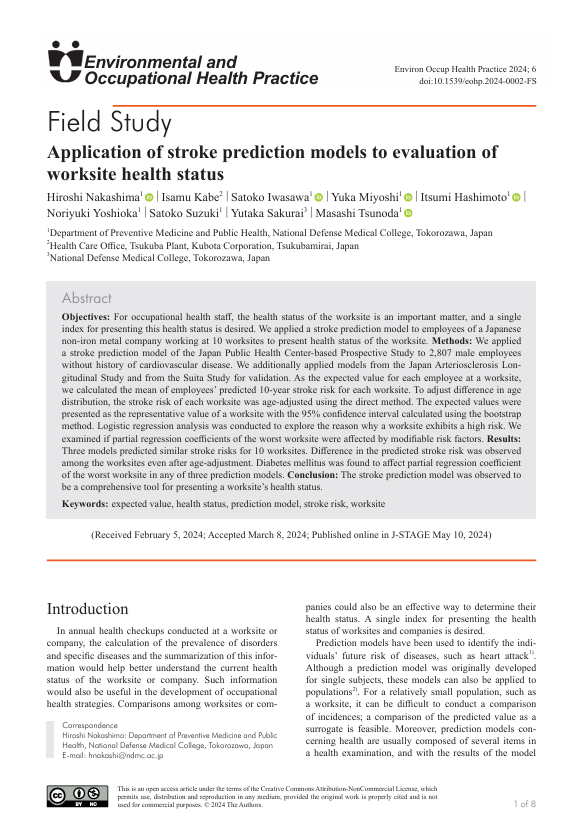
Link to original journal article:
https://www.jstage.jst.go.jp/article/eohp/6/1/6_2024-0002-FS/_pdf/-char/en
Title of the paper:
Application of stroke prediction models to evaluation of worksite health status
Authors:
Hiroshi Nakashima, Isamu Kabe, Satoko Iwasawa , Yuka Miyoshi, Itsumi Hashimoto, Noriyuki Yoshioka, Satoko Suzuki , Yutaka Sakurai, Masashi Tsunoda