#E0086 A personal sampler to simultaneously measure worker exposure to vapor and mist forms of benzyl alcohol

Title: A personal sampler to simultaneously measure worker exposure to vapor and mist forms of benzyl alcohol
Dicholoromethane is a colorless, volatile liquid that has long been used in paint removers but recently its use is declining as it is associated with serious health hazards especially in closed spaces.
Benzyl alcohol has recently been used as a substitute for dicholoromethane in paint removers for repainting structures, such as bridges. Its content in currently available paint removers could range from a small percentage to upto 75%. The application of benzyl alcohol-based paint removers requires the workers to apply paint often using sprayers, and leave the paint film to swell and soften before it is removed with a spatula or scraper.
This removal process of the paint from bridges often occurs in enclosed spaces, and there are reports of fatal intoxication accidents; however, the exposure level that led to these fatal intoxications is unknown. Thus, it is important to monitor the levels of benzyl alcohol in workplace air. The United States Department of Labor’s Occupational Safety and Health Administration (OSHA) aims to measure the vapor form of benzyl alcohol and recommends the use of XAD-7 without a glass fiber filter. However, the workers frequently apply the paint removers using sprayers and the mist from benzyl alcohol containing removers is widely recognized as the primary source of exposure to the workers.
In this study, the authors have developed and validated a personal exposure sampler that can simultaneously collect vapor and mist of benzyl alcohol (Connected sampler). The connected sampler consists of an adsorbent (Slim-J) and a glass fiber filter upstream (GL Sciences Inc., Tokyo, Japan). The connected sampler was validated through comparison with XAD-7.
Air sampling was conducted by attaching the connected sampler to the chest of a worker during bridge paint film removal. The connected sampler conducted measurements that maintained a recovery rate of about 90% for 120 min of collection in the range equivalent to the target range of 1/10 to 2 times (2.5-50 mg/m3) of 25 mg/m3, which is the upper allowable concentration set by JSOH. Ensuring precise measurement within this range is crucial for occupational health. The recovery rate of the connected sampler was almost 100% as compared to 70-80% for XAD-7, and it showed a 100% storage stability for 7 days at 0.26 to 5.2 mg (equivalent to 2.5-50 mg/m3). Thus, the connected sampler is a reliable and suitable sampler for measuring personal exposure levels of benzyl alcohol.
The findings of this study have significant implications for preventing fatal intoxication accidents among workers and ensuring a safe working environment. Future studies should focus on validating the connected sampler in real-world settings and determining its effectiveness for other chemicals.
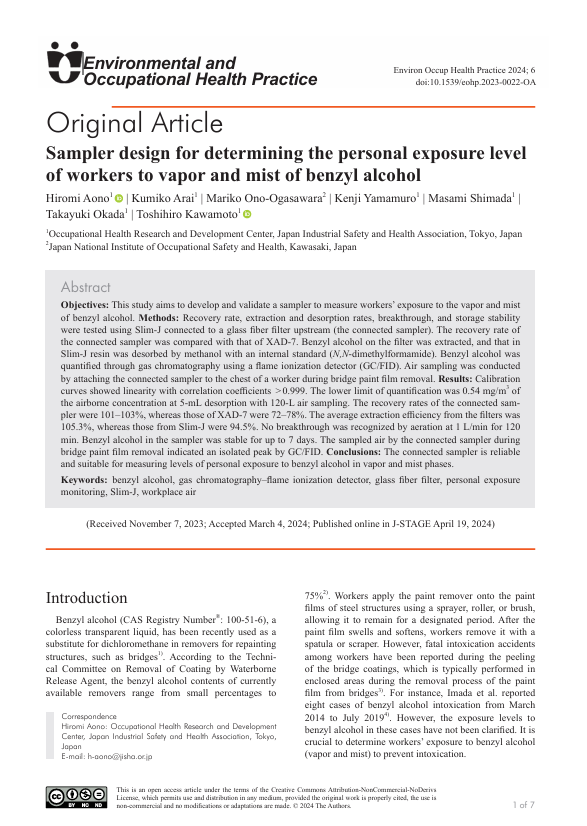
Link to original journal article:
https://www.jstage.jst.go.jp/article/eohp/6/1/6_2023-0022-OA/_pdf/-char/en
Title of the paper:
Sampler design for determining the personal exposure level of workers to vapor and mist of benzyl alcohol
Authors:
Hiromi Aono, Kumiko Arai, Mariko Ono-Ogasawara, Kenji Yamamuro, Masami Shimada, Takayuki Okada, Toshihiro Kawamoto