#E0089 Real-Time Air Monitoring: A Faster, Safer Solution for Workplace Chemical Exposure

Real-Time Air Monitoring: A Faster, Safer Solution for Workplace Chemical Exposure
Toluene is used in many cleaning tasks, but exposure to high levels can be dangerous. Current methods to measure chemicals, like gas chromatography–mass spectroscopy (GC–MS), are reliable but slow, making it hard to track sudden changes in chemical levels during short tasks. In this study, researchers introduce a new way to measure harmful chemicals in the air at work, focusing on a common solvent called toluene.
To solve the problem of slow chemical monitoring, the researchers created a faster, real-time system called ion-mobility spectrometry (IMS). This system works by identifying chemicals in the air based on how they move through a tube after being charged. The researchers tested IMS during a cleaning job that used toluene, a common solvent. They noticed that toluene levels in the air changed quickly during different parts of the cleaning process, like when the container was opened or closed. The IMS system measured these changes every minute and provided results that matched closely with a slower, traditional method called GC–MS, but IMS worked much faster.
In this study, authors mention that this new system can help keep workers safe by providing real-time monitoring of chemical exposure, especially in jobs where short bursts of high exposure happen. It is like having a smoke detector that instantly alerts you when there’s a danger, but instead of smoke, this system watches for harmful chemicals in the air. In certain jobs, workers are exposed to brief but intense bursts of chemicals, such as when someone is cleaning with strong solvents or painting a room. In these situations, the IMS system acts as a "real-time alarm" that constantly checks the air and immediately detects when chemical levels rise too high. If a worker opens a container of toluene, a solvent used in cleaning, the system will immediately spot any dangerous increase in toluene in the air and help ensure the worker’s safety.
While IMS might not be as effective at very low chemical levels, it works perfectly in the everyday situations found in many workplaces. This real-time monitoring will help to prevent health problems by quickly identifying when chemical exposure is risky, giving workers and employers a way to respond fast, preventing health risks in real-time. The study suggests that the IMS tool has the potential to be used in real-world workplaces to monitor the levels of chemicals and ensure a safe working environment.
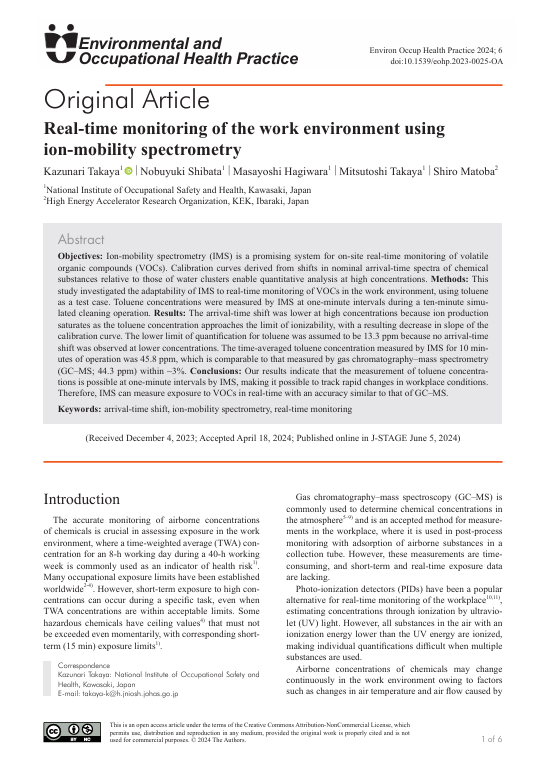
Link to original journal article:
https://www.jstage.jst.go.jp/article/eohp/6/1/6_2023-0025-OA/_pdf/-char/en
Title of the paper:
Real-time monitoring of the work environment using ion-mobility spectrometry.
Authors:
Kazunari Takaya Nobuyuki Shibata, Masayoshi Hagiwara, Mitsutoshi Takaya, Shiro Matoba